The future of brand advocacy is identity-led
In an era of polarization and PR landmines, a strong brand identity is your greatest defense and your most valuable asset.
Today’s politically charged and divided climate has made advocacy a double-edged sword. Brands that speak up can attract passionate loyalty or face fierce backlash. Brands that champion sustainability, inclusion or social causes are celebrated by some and canceled by others. The very idea of standing for something now risks being dismissed as “woke” on one side of the spectrum, or “greenwashing” on the other.
We see many brands becoming reactive, playing it safe, retreating from meaningful conversations, or pandering to whichever audience shouts the loudest. So, are we witnessing the death of brand advocacy? We don’t think so. But it is a sign that brands must truly know who they serve and why they exist.
Identity is the key
If there’s one quality that allows brands to weather cultural cycles and the unpredictability of public opinion, it’s a strong identity. In moments of calm, identity guides growth. In times of polarization, it becomes an anchor. Identity is central to human psychology. It provides people with stability, belonging, and meaning, even when the world shifts.
Collective identity plays a powerful role here. When individuals feel disconnected or threatened by societal change, they turn to groups, causes and brands that reflect their values and offer a sense of community. This is why purpose-driven brands can forge deep emotional loyalty. Not because of the products they offer, but because they validate and amplify shared identities.
Your brand’s identity is more than a mission statement and understanding it requires three things:
- Who you serve: People align with brands that reflect their values and aspirations and help them express who they want to be.
- Who you are: As a brand, what are your values and what do you stand for? As you mature, who do you aspire to become?
- Why you exist: Not just what you sell, but why you matter and what role you play in society.
The brands we choose say something about us—about our values, our beliefs, and how we want to be seen. We use brands to express who we are.
For brands, that means going beyond products and price tags. It means standing for something, and doing it in a way that people feel. When done authentically, this creates loyalty that can even withstand controversy.
|
Identity: The difference between a movement and a mess
|
| Identity misfire |
Identity in action |
|
Bud Light x Dylan Mulvaney
|
Mastercard x True Name
|
|
Bud Light partnered with trans influencer Dylan Mulvaney in a one-off social media promo. The Instagram video celebrated her transition anniversary by cracking open a Bud Light. The move surprised many, given Bud Light’s history of marketing toward conservative audiences. The campaign sparked severe backlash from its core customers and criticism from LGBTQ+ supporters, due to the brand’s lack of a clear or consistent response.
Why it failed: The partnership lacked alignment with Bud Light’s identity, making it seem opportunistic and poorly executed. It ultimately alienated multiple sides because the brand failed to take a strong stand in any direction.
Business results: Bud Light has long been America’s best-selling beer. But after the campaign sales dropped 17%, compared to the same week in the previous year, and were down 29% in the four weeks ending Oct. Meanwhile, rivals Miller Lite and Coors Lite both saw their sales jump over 17%.
|
Mastercard introduced the True Name initiative, giving transgender and non-binary people the ability to use their chosen name on credit and debit cards, without the burden of a legal name change. For many, it meant being seen for who they really are.
Why it worked: The campaign succeeded because it was aligned with Mastercard’s long-standing purpose: Connecting everyone to priceless possibilities. It felt consistent and credible because it aligned with everything the brand stood for: inclusion, dignity, and using tech to empower.
Business results: The “True Name” campaign generated over 3 billion impressions in its first three weeks, with an earned-to-paid media ratio of 19:1. It led to high-profile partnerships with banks and catalyzed broader industry change, as other financial institutions followed suit. It won several major advertising awards and boosted Mastercard’s reputation among younger audiences.
|
How the past reveals the future
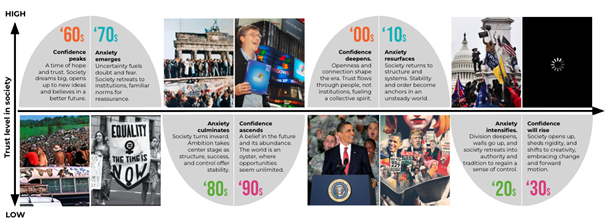
We see it time and again: the forces shaping society andbrands move in cycles. Beneath every surge of innovation or wave of public backlash lies a deeper current, driven by the rise and fall of trust in society.
The history of brand advocacy follows these patterns. Over the decades, brands have mirrored the collective psyche of their time. Today’s polarized climate is just the latest chapter in a repeating story. When collective trust rises, we open up, explore, embrace differences, and reimagine norms. When anxiety rises and trust declines, societies tighten their grip, lean into structures, and resist the unfamiliar.
What’s next? A bolder, more expressive age
While we can’t predict the future, societal change follows a certain logic. After a decade of instability and heightened anxiety, the emotional tide is shifting. Based on past cycles, moving into 2030 we can expect anxiety to recede, enabling society to open up and loosen the grip of protectionism, rigid norms, and fixed identities. We should see trust rise and a new era of confidence emerge—one defined by more expansive, daring, and creative mindsets.
Four hypotheses for 2030+
- Hunger for transformation and experimentation.
As fear loosens its grip, people will lean into change. They will reclaim authorship over who they are becoming. Autonomy, personalization and boundary-pushing will define the mindset, and the belief that better models are possible will drive innovation. We see early signs of this mindset in crypto, which rejects old systems in favor of building better ones.
Branding implications
Activism will be pragmatic and solution-focused. Don’t declare—demonstrate. Show what you’re building, changing, or fixing. Proof will matter more than descriptions.
Example
Ben & Jerry's "DIY activism" campaign invites people to be protagonists of change, not just passive supporters.
- Greater openness to ambiguity and paradox.
People stop demanding black-and-white answers and become more capable of adapting, better navigating nuance and complexity. They’ll tolerate ambiguity and imperfection if it’s owned with self-awareness, pragmatism, and action.
Branding implications
Share the journey without trying to be perfect. Instead, tell a layered, evolving narrative. People want to see your process, including the tension and effort.
Example
Eyewear brand Ace & Tate didn’t sugarcoat mistakes. In a blog post about their sustainability missteps, they opened with: “Look, we f*cked up.” That kind of honesty made them look real. And that built trust.
- Rise in polarization and radicalism
When people are no longer bound by fear, they feel more free to express bold and divergent views, resulting in a more irreverent and liberated cultural climate. We see the early seeds in the emergence of radically confident subcultures, from die-hard feminists like the 4B movement, to proud “Trad wives” to hyper-masculinists shaped by alpha male influencers. These subcultures seek sovereignty, fiercely defining their own identities.
Branding implications
Take sides. Identity will matter more than ideology, so people will rally around belonging and shared convictions, not just causes. Define your lane and stick to it.
Example
Nara Smith, known as a "trad wife" influencer, partnered with Marc Jacobs to create a unique advertisement where she bakes their tote bag “from scratch.” The campaign already has over 2.5 million views.
- Progress through diverse collabs
The next wave of progress won’t be top-down or come from lone heroes. It will come from collective, often messy, collaboration across people with diverse views.
Branding implications
Proudly outspoken brands will thrive by embracing contrast, welcoming dissent, and collaborating across perspectives. They will feed collective confidence, not consensus, by making space for voices unlike their own.
Example
Sky High Farm Workwear, a brand supporting food security initiatives, collaborated with Balenciaga to merge philanthropy with high fashion, exemplifying how brands with differing market positions can unite for social good.
The next era starts with knowing who you are
As we move toward 2030, this cycle offers more than insight—it offers perspective. Today’s tension is part of a deeper rhythm, one that points to rising trust, growing confidence, and a renewed opportunity for brand advocacy.
Brands that know who they are, who they serve, and why they exist are far better equipped to navigate a polarized landscape than those trying to be everything to everyone.
The brands that will succeed in this new era are not those that avoid taking a stand, but those that stand with conviction, clarity, and consistency. The key isn’t to shout louder or to silence yourself—it’s to know who you are and to act accordingly.
|
About Mai Huan-Maury
A sociologist and Transactional Analysis therapist with an academic background in psychology, sociology, and ethnology, Maï brings over two decades of expertise in understanding the complexities of human behavior and cultural dynamics. Born and raised in France by a Vietnamese father and a German mother, her multicultural upbringing fostered a natural open-mindedness and an enduring curiosity to explore human identity beyond labels. As a Business Humanizer at Innate Motion, Maï has a passion for helping companies and brands foster authentic and lasting connections with the people they serve. She firmly believes that building a brighter, more human future begins with understanding and honoring each person's singularity.
About Megan Pratt
Megan is a Business Humanizer at Innate Motion, where her background in neuroscience and passion for narrative come together. Born in Florida and now based in Seville, Spain, Megan’s personal journey mirrors her professional one: shaped by curiosity, empathy, and a love for translating complexity into clarity. She helps brands grow by understanding people not just as consumers, but as full, feeling humans immersed in rich cultural contexts. Over the past decade, she has worked with hundreds of brands around the world and across industries, turning human insight into strategic storytelling that drives meaningful business growth.
About Martina Peccerillo
A consumer behavior expert with a background in psychology, Martina is driven by a deep
curiosity for what shapes how people think, feel, and make decisions. After earning her Master’s in Consumer Psychology in the Netherlands, she returned to her hometown of Rome, where she is now pursuing an Executive Master’s in Marketing Management to expand her strategic expertise and stay closely connected to the latest innovations in the field. At Innate Motion, Martina works as a Business Humanizer, combining behavioral insight, cultural meaning, and purpose-led thinking to help brands grow with relevance and empathy.
|