The AI-fluent creative
Great ideas are built on experience and intuition, not just sparks of inspiration. With pressure mounting to create fast and deliver big, it’s no surprise marketeers are turning to GenAI to boost speed, spark energy and fuel the creative process.
In 2030, creativity won’t be replaced by AI. It will be redefined by it.
Just as smartphones transformed photography and social media turned every consumer into a content creator, creativity evolves with its tools. And GenAI? It’s the next evolution. But, this isn’t about handing over the reins. It’s about reshaping the creative journey. When AI becomes a co-pilot, the role of the marketer shifts; from doing all the thinking to directing it. From traditional ideation to strategic curation, knowing what to ask for and how to refine what comes back.
So, the real question isn’t what AI can do. It’s what human potential we want to amplify with it.
How AI makes marketers more effective
- Framing the challenge: to the heart of what matters
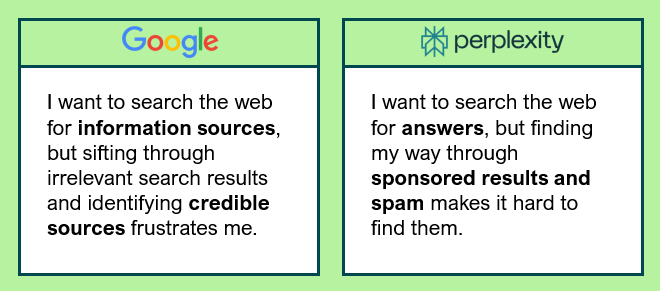
Let’s be honest: the world doesn’t need more random ideas. It needs better ones. More grounded, more relevant, more resonant. And that doesn’t start with a blank page, but with a sharp question. One that cuts through the noise and gets to the heart of what really matters. Take Perplexity, for example. Where Google built the world’s most powerful search engine, based on the underlying user problem of ‘searching the web for information’, Perplexity reframed it: what if people aren’t just looking for information sources, but for answers? That subtle shift – from sources to answers – transformed the entire user experience. It’s a powerful reminder that the path to stronger ideas starts with spending more time on understanding the problem.
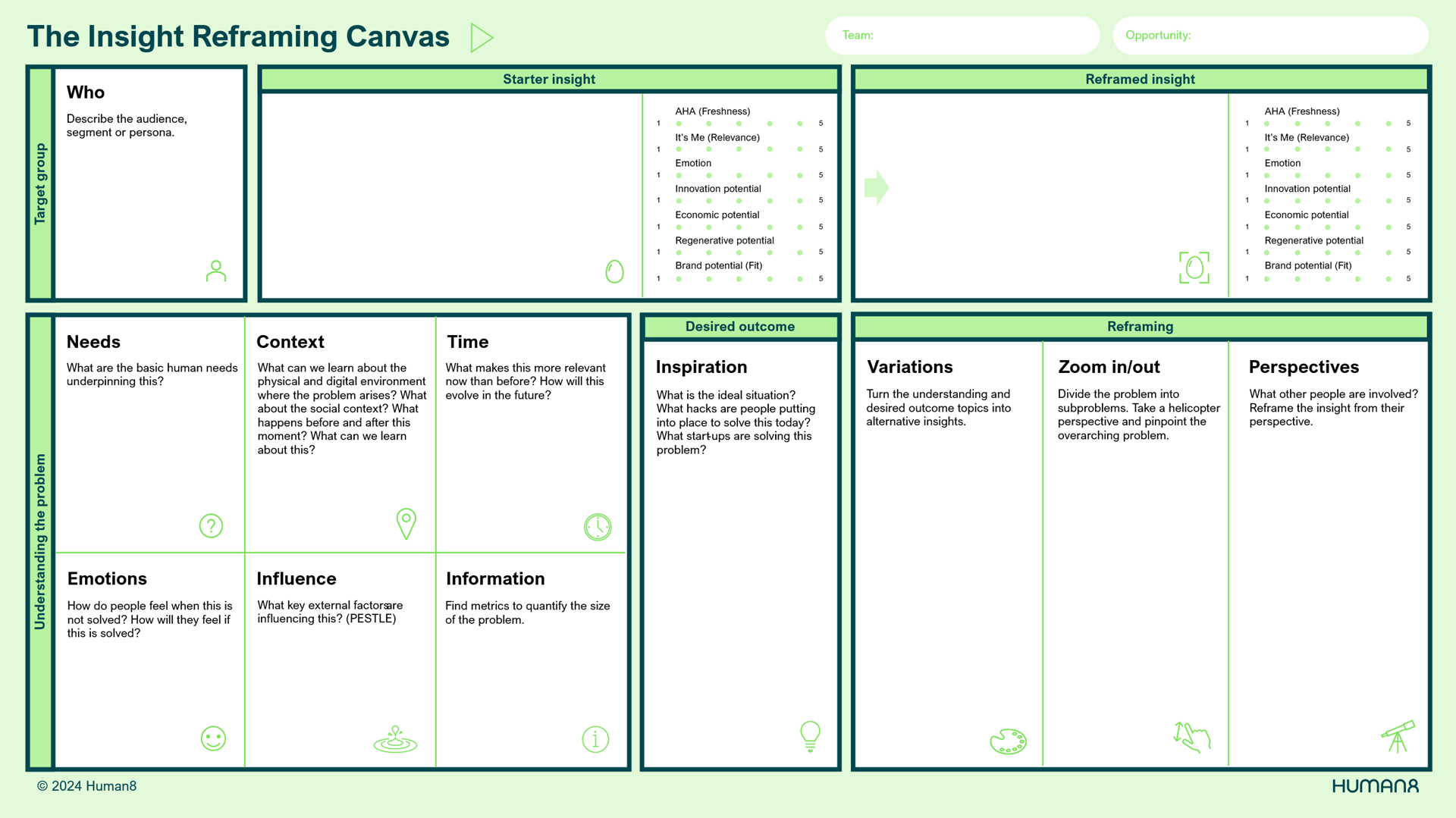
That’s where GenAI can play a crucial role. More than just a tool, it becomes a thinking partner. It helps teams move beyond vague briefs and surface-level insights, reframing challenges in ways that unlock fresh energy and direction. That’s why we’ve developed an Insight Reframing Canvas. We load our AI assistant with relevant consumer research and brand context, then use structured prompts to explore challenges from multiple angles. Instead of rushing to solutions, we dig deeper into the human truth: What's really driving this behaviour? What would success look like for different personas? This AI-assisted exploration typically uncovers insights that traditional briefing misses.
2. Supporting divergent thinking: wider, weirder and faster
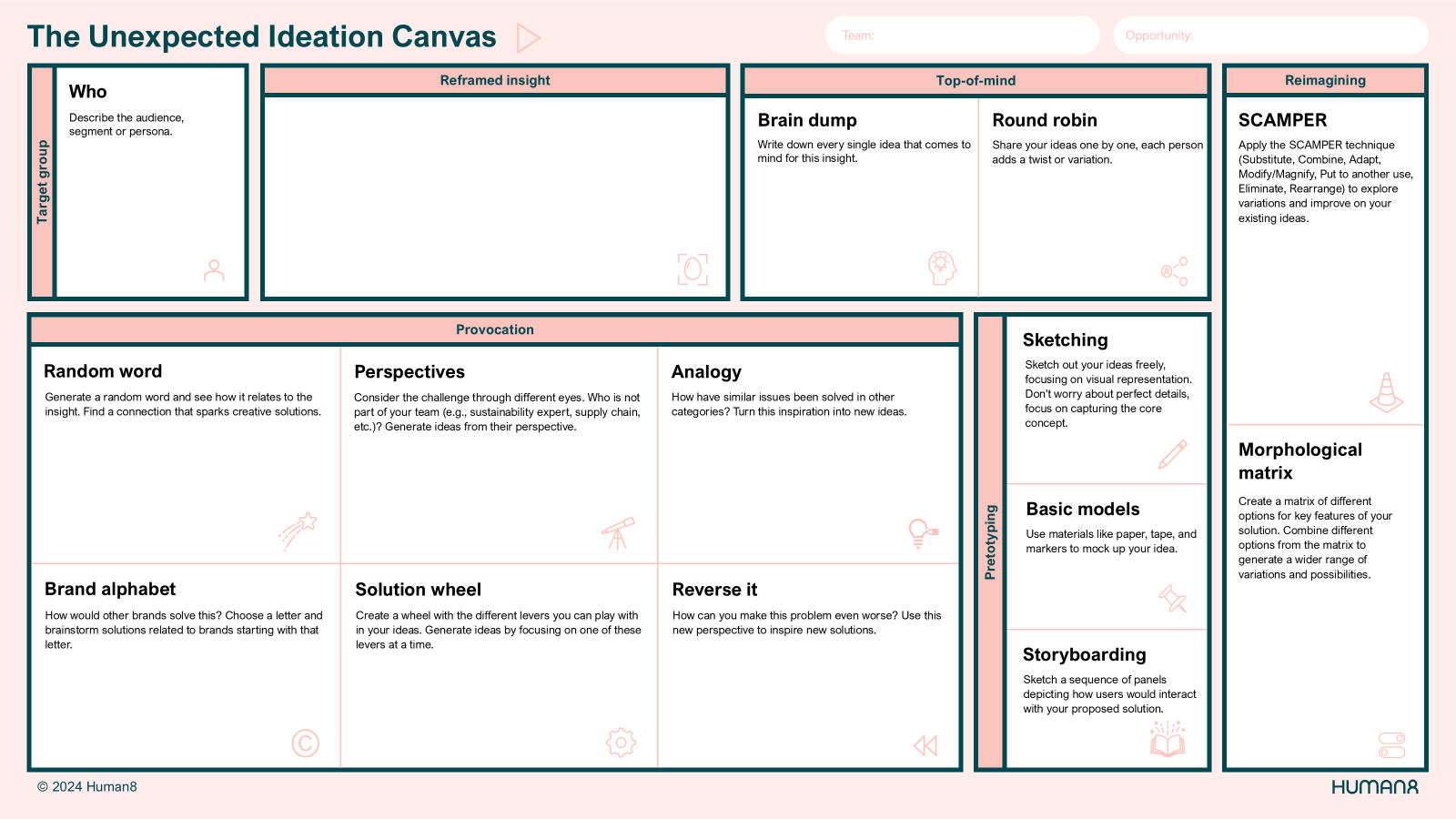
If great ideas begin with better problem framing, then bold ideas bloom from brave exploration. Divergent thinking is essential, as it encourages the generation of a broad range of ideas, leading to more innovative and creative solutions. It’s where imagination runs wild, where logic takes a backseat and creativity starts to colour outside the lines. This is where GenAI shines bright, acting as a creative catalyst. It doesn’t tire, hesitate or second-guess. Instead, it throws ideas at the wall and invites us to see what sticks. Pair it with the right techniques and you get real creative firepower. Our Unexpected Ideation Canvas is built exactly for this: to break the cycle of sameness and nudge teams toward surprising territory. From random word prompts to analogy prompts. These AI-boosted sparks help us think wider, weirder and faster, without losing touch with what’s real or relevant. It starts with human insight, fuelled by AI and sharpened through collaboration with stakeholders.
Because let’s be honest: ideation is often a numbers game. The more ideas you generate, the more likely you are to uncover something truly original. But time and budget rarely allow for endless exploration. That’s where GenAI earns its seat at the table, not to hand us polished answers, but to offer abundant starting points in seconds.
At its core, creativity is the art of unusual connections. And GenAI? It’s like a collaborator who’s read every book, seen every ad and still finds fresh ways to remix the old into something strikingly new. That’s how large language models work: detecting patterns and proposing new connections. Not every idea it generates is golden, but when used as a launchpad, it gives teams more to work with, more quickly.
So, when was the last time you followed the weirdest idea in the room, just to see where it might lead?
When fast becomes flat: the risks we must design around
Like any powerful tool, GenAI comes with fine print. Used without care, it can take us not forward, but in circles. Fast doesn’t always mean fresh. And polished doesn’t always mean powerful.
1. Sameness is the enemy of standout
Because GenAI is trained on what already exists, it can quickly regress to the average, producing ideas that feel familiar, comfortable or safe. Without diverse prompts, fresh inputs and clear creative boundaries, we risk drowning in a sea of déjà vu. If every brand uses the same tools in the same way, where’s the distinction? Marketeers must be intentional: curate your data, push your prompts and invite the unexpected.
2. The illusion of polish
GenAI speaks with confidence. But confidence isn’t the same as clarity or truth. A slick concept may look ready to pitch, but crack the surface and it may not hold. That's why critical thinking is non-negotiable. Every AI-generated idea needs human interrogation. That means acting as curators, challengers and editors: Is it right for our brand? Is it rooted in real need? Is it even possible? This human filter is vital to ensure creativity stays both sharp and true.
3. Trust, but verify
In our global What Matters 2025 Trend study, 59% of people expressed being worried about the consequences of using AI and new technologies. And rightly so. Ethics, IP, authorship and biases aren’t footnotes; they’re the foundation. But, using AI responsibly isn’t just about ethics, it’s about ensuring your creative output remains rooted in human truth.
GenAI can simulate, suggest and support, but it’s up to humans to validate, refine and own the final direction. To embed AI responsibly and effectively, you need three ingredients:
-
A secure and safe AI environment: a walled garden that ensures your commercial data stays protected and isn’t used to train public models.
-
A rich knowledge base: to fuel outputs that are relevant, differentiated and brand-specific, avoiding the generic traps of publicly trained models.
-
Deep subject-matter expertise: whether in marketing, innovation, branding or comms, human judgement is needed to guide, challenge and refine AI-generated ideas with strategic and creative intent.
This brings us to a crucial shift in mindset: stop obsessing over prompt engineering and start thinking in terms of context engineering. What matters most is assembling the right context. Think about sharing examples, background info, brand guidelines and conversation history to reduce the "fog of war" for your model. Don't spend time crafting clever prompts. Focus on giving AI a thoughtfully curated context that sets it up to win.
Looking ahead: the rise of the AI-fluent creative
We believe the future of marketing isn’t human or machine. It’s both. By 2030, creativity will be a team sport, a collaboration between intuition and iteration, between human insight and machine scale.
That’s where a new marketer archetype is emerging: the AI-fluent creative. A professional who knows how to brief better, frame sharper, think broader and push further. And all of this with GenAI as a partner. Not to cut corners, but to go deeper. Not to create faster, but to create smarter.
Because GenAI isn’t a gimmick. And it’s definitely not a silver bullet. But in the hands of those who understand its potential – and its limits – it becomes a lever for real, human-centred innovation.
Strategic success won’t go to those who use AI the most, but to those who use it most meaningfully.
Curious for more? Discover the human edge in the age of AI.
|
About Thomas Troch
As Partner and Head of Innovation Solutions at Human8, Thomas Troch leads global innovation strategies that transform businesses and create meaningful human experiences. With 15 years of experience, he has partnered with Fortune 500 companies to unlock growth by making their products, services and communications hyper-relevant to consumers.
Thomas's expertise lies in developing and optimizing innovation solutions fueled by GenAI, leading qualitative and quantitative consumer insights programs, facilitating workshops that spark empathy, creativity, action, and applying design thinking and open innovation methodologies.
He has had the privilege of working with iconic brands such as Anheuser-Busch, Google, L'Oréal, Mars, PepsiCo and Bloomingdale's, delivering award-winning innovation programs that have significantly impacted their market position and growth.
|